WITH · WHAT ACTUALLY WORKS
Trying to fix your snoring? Here's how to tell what actually works.
Almost nobody fixes this on the first try. It's usually a pillow, then maybe tape, then side-sleeping, then maybe a doctor. The trouble is comparing them — because by feel, they all kind of blur together. The measurement is the one thing that doesn't.
You'll probably work through a few of these before something sticks. The catch is that "I think that one helped" is unreliable — snoring swings night to night, and half of these fixes do very little for any given person. So keep one thing constant while you swap fixes: the measurement. Record your nights on the phone by your bed — free — see and hear your snoring and breathing pauses, tag what you tried, and let the data tell you which one actually moved your number. Nothing to wear.
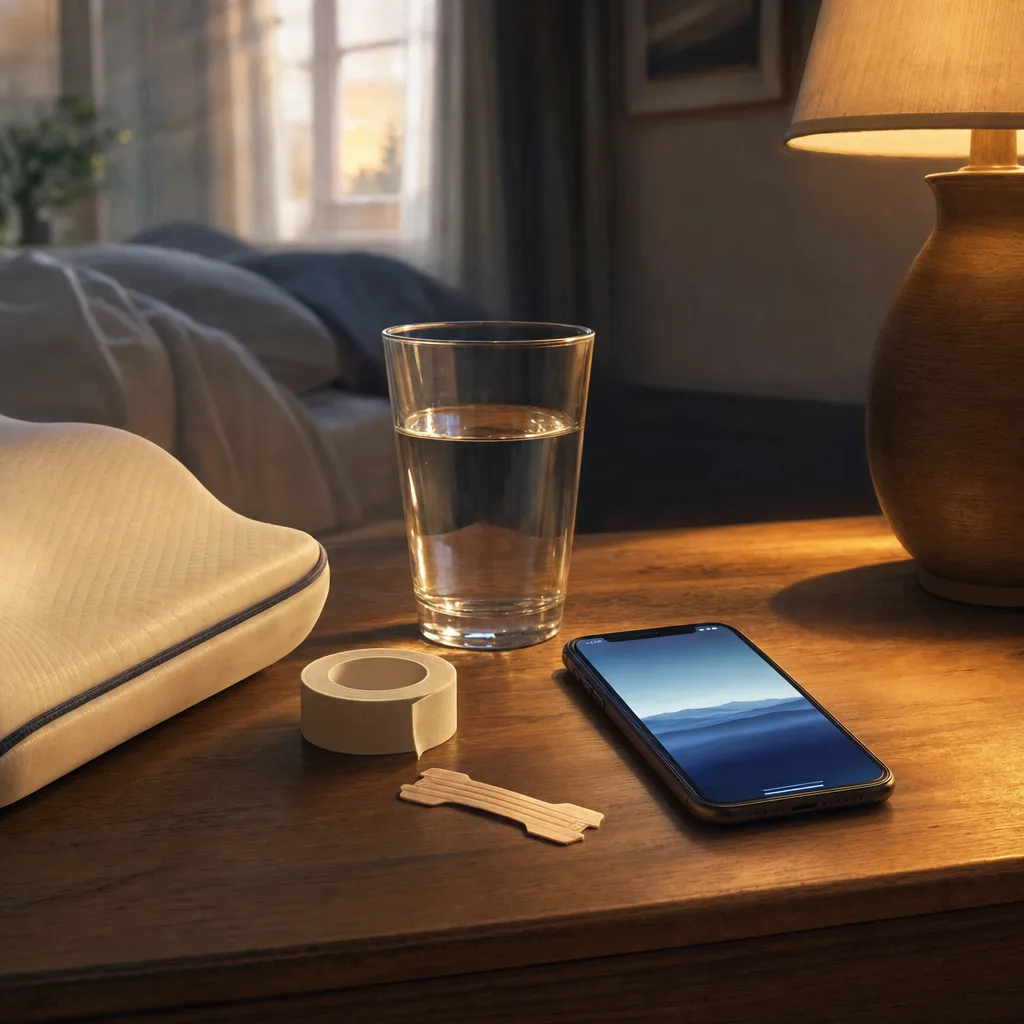
The problem isn't the fixes. It's comparing them.
Each of these can genuinely help the right person. The pillow, if your snoring is positional. Mouth tape, if you're a mouth-breather. Side-sleeping, if gravity is the issue. A CPAP, if it's more serious than any of that.
The problem is you have no way to tell which of those is you — and by feel, you never will. You try the pillow for a week, sleep felt okay, you're not sure. You add tape, maybe a bit quieter, maybe not. Three fixes and a hundred dollars later, you still don't actually know what helped. That's not a discipline problem. It's a measurement problem.
Pick one to test — here's how each works
Start with whichever you've already got or already bought. Each of these pages walks through testing that specific fix inside your return window:
- → Does your anti-snore pillow actually work? — the blind buy most people start with.
- → Does mouth taping actually help? — cheap and trendy; easy to overrate.
- → Does side-sleeping actually help? — free and low-risk; worth trying first.
- → Do nasal strips (or nostril clips) actually help? — only if your problem is really your nose.
- → Do anti-snore nasal sprays actually work? — big promise, thin proof; one kind can backfire.
- → Already on CPAP? — how the two work together on the nights the mask slips.
The measurement is the constant
Here's the part that makes the whole thing work: you don't restart from zero every time you try something new. You record continuously and tag what you're testing — the pillow nights, the tape nights, the side-sleeping nights. Over a couple of weeks, the Lifestyle Lab™ lines each of those up against your breathing number and shows you which factors actually moved it.
So instead of "I think the pillow maybe helped," you get "the pillow did nothing, but the two weeks I actually stayed on my side dropped my number by 4 an hour." That's a decision you can make on evidence — and it's the same instrument grading all of it, so the comparison is fair.
We don't sell the fix. We score it.
Every product in this space is trying to sell you the fix. I'm not — I don't make any of them, and I don't earn anything when you buy one. SomniSense is the neutral instrument that stays constant while the fixes come and go, so you can actually find the one that works for you instead of guessing your way through a drawer full of gadgets.
Free to start · Pro adds the multi-night before/after and the doctor-ready report · 7-day free trial, cancel before day 8 to avoid the charge.
Read next
Common questions
- Why do I need to measure? Can't I just tell if I'm sleeping better?
- Because snoring changes night to night, and 'I think I slept better' is exactly the signal that's unreliable. Half the fixes people buy do very little for them personally — but by feel, a placebo night and a real improvement look the same. Measuring is how you tell them apart.
- How does it compare one fix against another?
- You record your nights and tag what you tried — the pillow week, the tape week, the side-sleeping week. Over time the Lifestyle Lab™ lines up each factor against your breathing number, so you can see which ones actually moved it and which didn't.
- Do I have to buy anything to start?
- No. Seeing and hearing your own snoring and breathing pauses is free — that's how you get a baseline. The multi-night before/after and the doctor-ready report are the paid part.
- Do you sell any of these fixes, or recommend one?
- No, and that's the point. I don't make pillows, tape, or gadgets, and I don't take affiliate money on any of them. SomniSense is the neutral instrument that grades whatever you try. What you keep is your call, and your doctor's.